

The working principle of a plate heat exchanger unit
Release time:
2022-12-05 17:29
Source:
Plate heat exchanger units are composed of plate heat exchangers, circulating system pumps, make-up pumps, motor control devices, descaling devices, pipelines, gate valves, instrument panels, bases, etc., forming an overall thermal device. Customers only need to connect the unit's primary heat source, heated device, and make-up water ports, plug in the power supply, and it can be used. Applicable to several substances such as steam-water, water-water, water-oil, and oil-oil. It has advantages such as superior performance, reasonable layout, compact structure, reliable operation, and convenient assembly and operation.
Secondary water, after filtration and descaling, enters the heat exchanger through the circulating system and is heated by steam or continuously high-temperature water for heating. After the steam or high-temperature water enters the plate heat exchanger, it becomes condensate or continuously high-temperature intelligent return water back to the heat source, carrying out a control loop circulation system for primary and secondary heating. The make-up pump pumps softened water into the system to maintain stable output pressure.
Steam or high-temperature water, with the cooperation of a temperature regulating valve, is sent into the plate heat exchanger unit according to the total flow rate required by the heating system. The heat exchanger uses indirect heat transfer to heat the user's heating (central air conditioning) intelligent return water; the heated water first flows through the stainless steel plate core descaling device, then passes through the circulating water pump into the heat exchanger to be heated and supplied to the user, and the cycle repeats. The primary heat source returns to the primary heating network after heat transfer in the plate heat exchanger unit. The comprehensive water flow loss is automatically compensated by the make-up pump according to the set operating pressure, ensuring stable output pressure and normal operation.
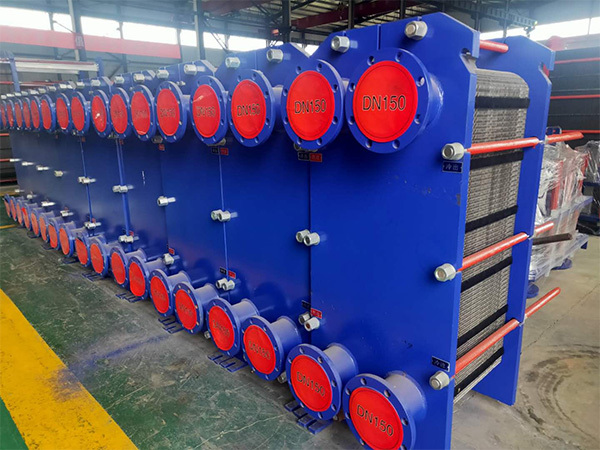
Plate heat exchanger units have the characteristics of high efficiency, environmental protection and energy saving, intelligent system, and automation technology. They can be widely used in factories, government agencies, schools, residential communities, independent villas, and other industrial buildings; large shopping malls, hotels, restaurants, and resorts and other commercial buildings' heating, central air conditioning, bathing water, drinking water, and swimming pool winter water. It can be used to produce industrial process water and various places requiring heat transfer.
①The plate heat exchanger unit uses industrial control equipment calculation or an intelligent temperature controller to enable an intelligent power supply temperature control system; that is, the power supply temperature can change according to the process setting, outdoor ambient temperature, standard room temperature, and time, achieving high heating quality and energy saving.
②The industrial control computer displays, stores, and prints various control parameters, including: the total flow rate of the heat source, heat source temperature, heat source pressure, heating capacity, outdoor temperature, standard room temperature, power supply temperature, condensate temperature, and supply water pressure.
③When the carbonated beverage is heated, a condensate heat transfer section and condensate temperature control are set to make flexible use of the condensate heat.
④The system water replenishment and moisturizing uses variable frequency control, automatic water replenishment, and pressure stabilizing pipes.
⑤High-performance stainless steel plate heat exchangers are used, resulting in a small generator set size and small footprint.
⑥The circulating water pump is variable frequency and operates independently.
⑦Standard modular design; the control content can be flexibly selected according to customer needs, reducing investment.
⑧Control parameters are centralized and digitally displayed, making them convenient and reliable.
⑨The plate heat exchanger unit has a compact structure. It uses high-efficiency and small-sized plate heat exchangers designed and manufactured by our company, and the pumps use imported or domestically produced high-quality vertical pumps, etc. The structure is compact, requiring a small assembly space.
⑩Easy to use and convenient for assembly and maintenance. The heat exchanger unit's control and heat transfer adjustment use imported or well-known domestic brand control components and systems. The operation is reliable, the performance is excellent, and the automation level is high. Simple training is all that is needed to master the operation of the plate heat exchanger unit.
Related News
WeChat Mini Program
WeChat public account
Service line:
Mobile:+86-15064136769
+86-13869137166
Mailbox:zhilin@sdzhilin.cn
Address: South Park, Jinan Economic Development Zone, Shandong Province