

Knowledge on the debugging and cleaning of heat exchangers
Release time:
2023-01-03 11:20
Source:
Due to the long-term operation of the heat exchanger unit, different degrees of fouling or deposits will occur on the surface of the heat transfer plate, increasing the flow resistance and reducing the heat transfer function. This is mainly manifested in the increase of inlet and outlet pressure and pressure difference, and the decrease of the outlet temperature of the cooling medium. Therefore, the heat exchanger unit can only be used after we have cleaned itUseto ensure the normal use of the product, and then debugging and testing can be carried out. So what should be paid attention to during the debugging process?
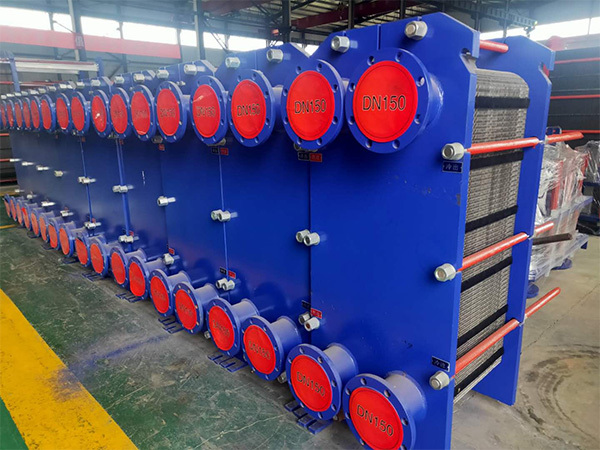
1.Heat Exchanger UnitThere should be a certain number of inspection positions around.
2. Before installation, the pipes of the connecting plate should be cleaned to prevent sand, oil, and welding slag from enteringHeat Exchanger Unitcausing flow blockage or plate damage.Heat Exchanger UnitSmall footprint and light weight. In addition to the size of the equipment, no extra inspection and installation space is needed. The thickness of the plate used for heat exchange is only0.6-0.8 mm
3.Heat Exchanger UnitStart and stop in sequence. First, close the high-pressure side of the dielectric solenoid valve, and then close the low-pressure side of the dielectric solenoid valve. In today's emphasis on efficiency, environmental protection, and energy saving,Heat Exchanger Unitis becoming increasingly important in the field of heat exchange. It can be used in heating, cooling, food sterilization, and other processes, and also has significant economic benefits in recovering low-grade thermal energy. When starting, first open the low-pressure side dielectric plunger valve, and then slowly open the high-pressure side dielectric plunger valve.
4. Check whether all the locking bolts are loose before use. If loose, tighten them. In recent years,Heat Exchanger Unithas replaced traditional shell and tube heat exchangers in airports, hotels, commercial buildings, etc., and has achieved good results.
5. Maintenance and Maintenance:
If there may be large particles of sand or debris in the medium frequently, it should beHeat Exchanger Unitbefore configurationHeat Exchanger Unitproduced supporting cleaning agents.Heat Exchanger UnitLow fouling factor, the fluid flows violently between the plates, forming turbulence. The good plate design avoids the existence of dead zones, making it difficult for impurities to deposit and block in the channel, ensuring good heat transfer effect.
With the accumulation of time,Heat Exchanger Unitunder long-term heat exchange conditions, scaling will occur, leading to blockage of the plate heat exchanger manufacturer's heat exchanger, low heat exchange efficiency, and inability to achieve the original heat exchange effect. It brings many inconveniences to users.
Long-term scaling will lead to deterioration of heat exchange conditions, and the heat exchange surface of the heat exchanger unit will exceed the rated temperature or local overheating, which may lead to tube rupture and explosion of the heat exchanger, causing accidents. Increased energy consumption, energy-saving effect cannot be achieved. The accumulation of fouling threatens the safe operation of the heat exchanger, reduces the service life of the heat exchanger, and causes the heat exchanger to face the problem of equipment shutdown maintenance. In serious cases, the original heat exchanger unit should be scrapped and replaced with a new heat exchanger unit.
If the water quality control does not meet the standard, and unqualified softened water is injected into the heating system,willcause calcium, magnesium, and carbonate rocks to decompose into calcium carbonate and magnesium hydroxide in water,thusbonding to the surface of the heat exchanger unit, forming hard scale. Due to scale, the heat exchange efficiency of the heat exchanger unit is reduced, and heat energy is severely wasted. This affects the heating effect and brings serious negative impacts to the heating unit.SoHeat Exchanger Unitcleaning is very important.
Related News
WeChat Mini Program
WeChat public account
Service line:
Mobile:+86-15064136769
+86-13869137166
Mailbox:zhilin@sdzhilin.cn
Address: South Park, Jinan Economic Development Zone, Shandong Province