

Some knowledge points about intelligent heat exchangers
Release time:
2020-12-22 18:04
Source:
www.sdzhilin.cn
Working Principle of the Intelligent Heat Exchanger Unit:1.Intelligent Heat Exchanger UnitofThe heat exchanger unit includes three parts: primary side, secondary side, and water supply system. The primary side is the heat source, and the secondary side is the heat user. The primary side heat source transfers heat to the secondary side through a plate heat exchanger. The secondary side has a circulating water pump that continuously transmits heat to the user. The makeup water system is connected to the return water of the secondary side plant T, usingFto supplement the water loss in the secondary side circulation and maintain the stability of the system pressure.2.Water Supply Temperature Control Principle:The intelligent heat exchanger unit is equipped with an independent control system that can complete functions from flow regulation to data acquisition and analysis according to user requirements, thereby regulating the user's water supply temperature to meet the heating and comfort requirements in the audit.
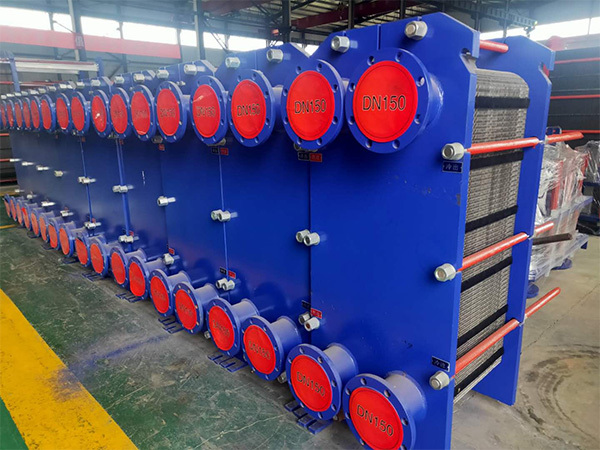
Uses of the Intelligent Heat Exchanger Unit: Used in units with large hot water demands such as bathing, laundry, hospitals, government agencies, and enterprises and institutions.Components of the Intelligent Heat Exchanger Unit: Water pump, volumetric heat exchanger, temperature control valve, temperature sensor, control system, drain valve, and electronic water processor.

Intelligent Heat Exchanger UnitofFeatures:1.Significant reduction in primary heat source temperature; addition of a drain valve at the end for easy maintenance.2.High-efficiency energy-saving volumetric heat exchanger with small cold water area and high volume utilization rate.3.With circulating pump,5-10seconds to produce hot water, no cold water zone.4.Adding an electronic water processor can kill bacteria and algae, and descaling is more conducive to health..5.High heat exchange efficiency, energy saving.
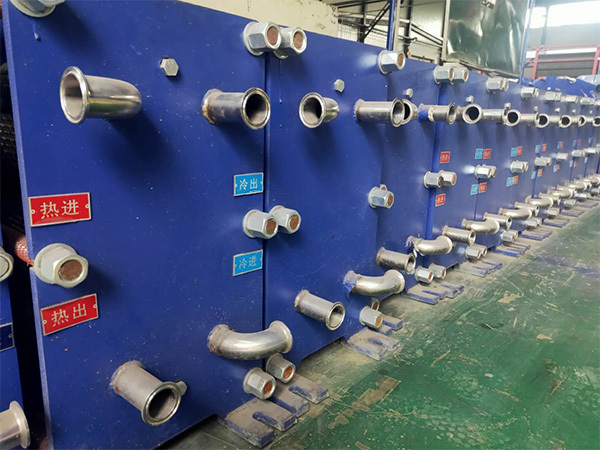
The intelligent heat exchanger unit retains the advantages of large water storage capacity, low head loss, safe and stable water supply, and convenient descaling of the heat exchanger.:
1.The temperature drop of the heat transfer medium in the volumetric heat exchanger is relatively large. When steam and water exchange heat, the outlet temperature of the condensate is50or so, and drain valves should be installed above and below the return water pipe for easy use and maintenance. In the water-heat exchange process, the heat exchange temperature is reduced to2~2.5times that of similar heat exchangers, at120~150and after heat exchange with high-temperature hot water, it can be reduced to70~75。
2.This invention has good heat exchange effect, good heat dissipation effect, small heat dissipation loss, and energy saving. At the same time, when steam is used as the heat medium, about15% of the condensation heat can be recovered.
3.Small cold water area and high volume utilization rate.
4.Retains the advantages of large water storage capacity, low head loss, safe and stable water supply, and convenient descaling of the volumetric heat exchanger.
Related News
WeChat Mini Program
WeChat public account
Service line:
Mobile:+86-15064136769
+86-13869137166
Mailbox:zhilin@sdzhilin.cn
Address: South Park, Jinan Economic Development Zone, Shandong Province