

Three common types of plate heat exchangers
Release time:
2021-04-14 17:11
Source:
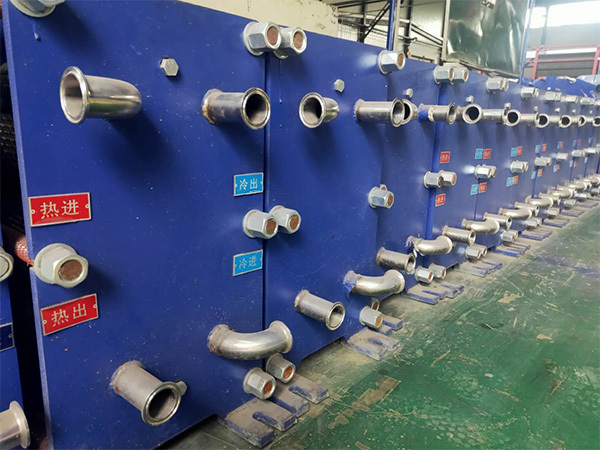
Recently, the plate heat exchanger market has developed rapidly. It has advantages such as high heat transfer coefficient, large logarithmic mean temperature difference, small footprint, light weight, and low fouling factor. At the same time, it is easy to disassemble and clean, and different structural types of plates can be flexibly combined. It can be used in various industrial applications such as heating, cooling, evaporation, condensation, sterilization and disinfection, and waste heat recovery. The structure of plate heat exchanger products is becoming increasingly rich. Here, we will look at three common types of plate heat exchangers.
I. Spiral Plate Heat Exchanger
Advantages: The spiral plate heat exchanger has a compact structure and provides a large heat transfer area per unit volume. The fluid is allowed to flow at a higher speed in the spiral plate, and the fluid flows in the spiral direction, resulting in a thin stagnant layer, so the heat transfer coefficient is large, and the heat transfer efficiency is high. In addition, due to the high flow rate, dirt is not easy to stay.
Disadvantages: The spiral plate heat exchanger requires high welding quality and is difficult to maintain. It is heavy, has poor rigidity, and special attention should be paid during transportation and installation.
II. Plate Heat Exchanger
A plate heat exchanger is a new type of high-efficiency heat exchanger composed of a series of metal plates with a certain corrugated shape. Thin rectangular channels are formed between the plates, and heat exchange is performed through half-plates. Compared with conventional shell and tube heat exchangers, under the same flow resistance and pump power consumption, its heat transfer coefficient is much higher, and it has a tendency to replace shell and tube heat exchangers within its applicable range.
III. Plate-Fin Heat Exchanger
It consists of a heat exchanger plate bundle enclosed in a collector box with cold and hot fluid inlets and outlets. The plate bundle is composed of flat plates and corrugated fins that are alternately stacked and brazed together. The cold and hot fluids exchange heat on both sides of the flat plate, the fins increase the heat transfer area, and promote fluid turbulence, and have a strengthening effect on the equipment. The plate-fin heat exchanger has a very compact structure, good heat transfer effect, and can withstand pressures up to 15 MPa. However, its manufacturing process is complex, the flow channels are small, and internal leaks are difficult to repair, so it is limited to clean, non-corrosive fluids, such as heat exchangers used for air separation.
Previous Page
Related News
WeChat Mini Program
WeChat public account
Service line:
Mobile:+86-15064136769
+86-13869137166
Mailbox:zhilin@sdzhilin.cn
Address: South Park, Jinan Economic Development Zone, Shandong Province