

A one-minute summary of the advantages of industrial plate heat exchangers
Release time:
2021-12-16 11:22
Source:
A heat exchanger is a device that transfers heat from one source to another. These devices are used to regulate temperatures within sewers, air conditioners, or refrigerators, and are also frequently used in automobiles and buildings. Some industries rely on heat exchangers daily to prevent fires and damage, while also using them for the heating and cooling needs of residential or industrial liquids. The water used in tanks uses energy. Liquids used in industries such as food and medical, when necessary, can use plate heat exchangers. Plate heat exchangers are mobile devices. Heat transfer between metal plates. Unlike traditional heat exchangers, the plate type is preferred because the liquid is dispersed over a larger surface area, thus increasing the exchange speed. The metal pipes of this heat exchanger are used to heat the fluid.
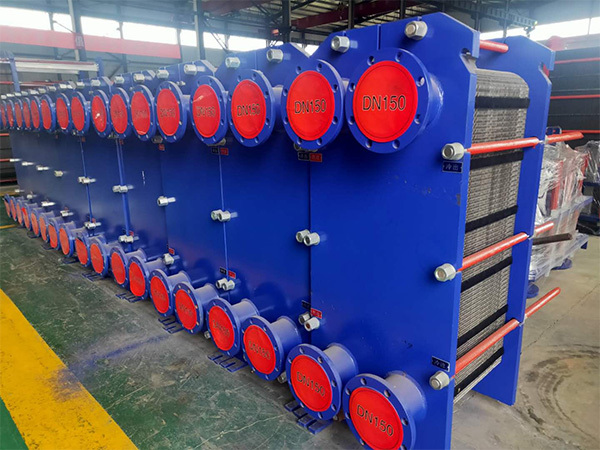
Plate heat exchangers, depending on their external and internal components, have plates welded together, brazed plate heat exchanger models that have undergone vacuum brazing. Due to the different internal components of different heat exchangers, smaller parts often work better in many cases, with some chambers designed to be very thin, making most of the liquid contact plates, improving heat transfer. Smaller coils can withstand more pressure, making the plate heat exchanger advantageous for a variety of applications, being durable, portable, and easy to maintain.
Industrial plate heat exchangers have significant characteristics and advantages, mainly including high heat exchange efficiency, small footprint, high energy efficiency, investment savings, and reliable performance. Therefore, it can replace traditional heat exchange equipment and is becoming increasingly widely used in the market.
I. What are the technical characteristics of industrial plate heat exchangers?
1. The theory of thermal mixing is adopted, that is, mixing at large and small angles. The heat exchange effect formed at different angles is different, so mixed use can often achieve the ideal heat exchange effect.
2. The gasket structure of the industrial plate heat exchanger is ridge-shaped. The advantages of this are enhanced sealing, reduced deformation of the gasket and heat exchange plate during disassembly, and high assembly precision.
3. The hanging structure of the dovetail group makes the hanging of the heat exchange plate more solid and correctly positioned, which is conducive to disassembly.
4. The crests and troughs of the heat plate of the industrial plate heat exchanger adopt a circular arc design and are uniformly pressed by a pressure machine. This wave, while increasing the support strength, can reduce accumulation and improve the internal point capability.
5. The quick bolt structure design makes maintenance and maintenance more convenient and quick, without affecting industrial production.
In the exchange of hot and cold media, industrial plate heat exchangers are also very strong in energy recovery and application. The advantages of the flexibility of heat exchangers in mechanical manufacturing, petrochemical, and food and beverage industries can improve its efficiency for more complex working conditions, reduce energy consumption, save costs for enterprises, and improve the service life and recycling of production equipment.
Related News
WeChat Mini Program
WeChat public account
Service line:
Mobile:+86-15064136769
+86-13869137166
Mailbox:zhilin@sdzhilin.cn
Address: South Park, Jinan Economic Development Zone, Shandong Province