

Compared with shell and tube heat exchangers, what are the characteristics of plate heat exchangers?
Release time:
2022-01-15 12:03
Source:
Plate heat exchangers are a new type of heat exchanger formed by stacking a series of metal plates with a certain corrugated shape. Thin rectangular channels are formed between the various plates, and heat exchange is performed through the plates. They are ideal equipment for liquid-liquid and liquid-vapor heat exchange. So, compared with shell and tube heat exchangers, what are the characteristics of plate heat exchangers?
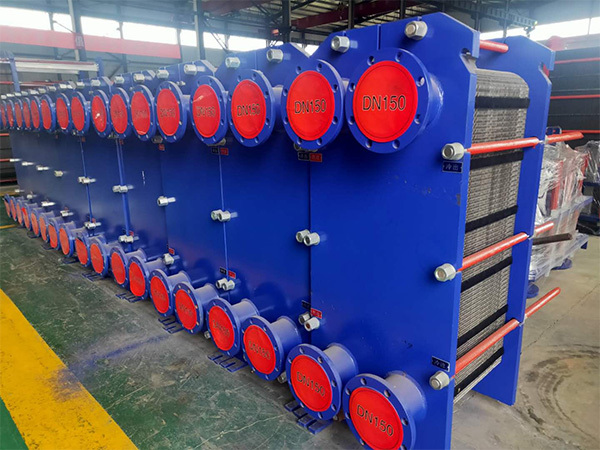
1. High heat transfer coefficient
Shell and tube heat exchangers have high structural strength, but their heat exchange is somewhat insufficient. When the heat exchange fluid flows in the shell, it bypasses the baffle-shell, tube bundle-shell, and baffle-heat exchange tube, and does not complete sufficient heat exchange. Plate heat exchangers have no bypass, and the inherent corrugated shape of the plate causes strong turbulence in the fluid at lower flow rates. Therefore, plate heat exchangers have a higher heat transfer coefficient, generally 3-5 times that of shell and tube heat exchangers. To complete the same heat exchange task, the heat exchange area of a plate heat exchanger is only 1/3 to 1/4 that of a shell and tube heat exchanger.
2. Small footprint
Plate heat exchangers have a compact structure, and the heat exchange area per unit volume is 2-5 times that of tube heat exchangers. In addition, the maintenance of the inlet pipe of tube heat exchangers requires a larger maintenance station, while plate heat exchangers only need to reserve a smaller maintenance area for plate replacement. In heat exchange work, the footprint of a plate heat exchanger only needs 1/5 to 1/10 that of a shell and tube heat exchanger.
3. Large logarithmic mean temperature difference
In shell and tube heat exchangers, the incorrect flow direction of the fluid uses a small correction coefficient for the logarithmic mean temperature difference. In plate heat exchangers, the fluid flows in parallel or countercurrent, and the correction coefficient of the logarithmic mean temperature difference can be as high as 0.95.
4. Low investment cost
Plate heat exchangers have a simple structure, and in terms of material cost, the price is much lower than that of tube heat exchangers.
5. Low fouling factor
The fluid inside the plate heat exchanger is intensely turbulent, making it difficult for impurities to accumulate. The flow jet in the plate channel is small, the heat transfer surface is smooth, there are few deposits, and cleaning is easy. The fouling factor of a plate heat exchanger is much smaller than that of a tube heat exchanger.
6. Can achieve heat transfer of multiple media
Intermediate plates can be installed to perform heat transfer for three or more media, but shell and tube heat exchangers cannot perform heat transfer for various media.
7. Heat exchange area and process combination are easy to change
To increase or decrease the heat exchange area, simply add or remove plates. If there are new heat exchange conditions, simply change the process combination.
8. Easy to clean
Simply remove the clamping bolts of the plate heat exchanger, loosen the plate bundle, and disassemble the plates for cleaning. This is very convenient for processes that require frequent cleaning of heat exchange equipment.
The characteristics of plate heat exchangers are very advanced and superior, and they have been widely used in various fields of civil and industrial applications.
Related News
WeChat Mini Program
WeChat public account
Service line:
Mobile:+86-15064136769
+86-13869137166
Mailbox:zhilin@sdzhilin.cn
Address: South Park, Jinan Economic Development Zone, Shandong Province