

Analysis of Plate Heat Exchanger Plate Design Characteristics from a Manufacturer's Perspective
Release time:
2022-03-31 09:12
Source:
Plate heat exchangers are important components in refrigeration systems. They consist of a set of corrugated metal plates. The plates have four corner holes for the passage of two heat transfer fluids, guiding the fluids to flow alternately through their respective channels for heat exchange. They are closely arranged, highly precise, small in size, highly efficient in heat exchange, space-saving, with high environmental requirements. They are suitable for small refrigeration units and are widely used in metallurgy, petroleum, chemical, food, pharmaceutical, and other industries.
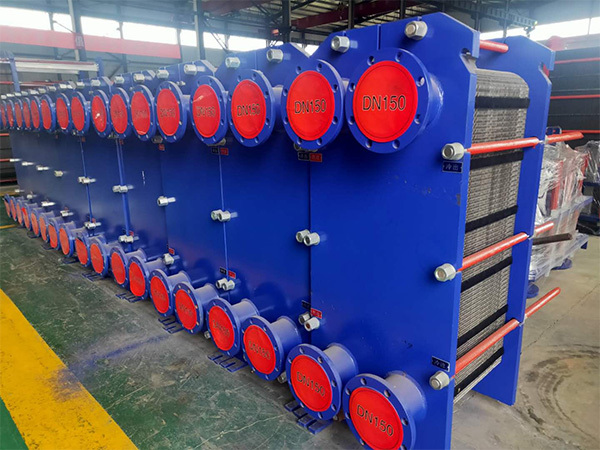
Heat exchanger manufacturers indicate that if a plate heat exchanger has an intermediate partition plate, one unit can exchange heat for three or more media (multiple intermediate partition plates). Plate heat exchangers with multi-media heat exchange are frequently used in dairy processing. Shell and tube heat exchangers cannot exchange heat for multiple media in one unit.
However, heat exchanger manufacturers also point out that plate heat exchangers use back-gasket sealing. The sealing perimeter is long, and the support for the two seals at the corner holes is poor. The gasket does not receive sufficient clamping force, so the maximum working pressure of the plate heat exchanger is currently only 2.5 MPA; when the single-plate area is 1 square meter, the working pressure is often less than 2.5 MPA.
Today, the heat exchanger manufacturer shares the four main design features.
I. Distribution Zone Design
Even with the widest plates, the fluid can be evenly distributed to every corner of the plate, minimizing pressure loss in the distribution zone. The heat exchanger manufacturer indicates that all heat exchange areas are involved in heat exchange, and all physical areas are transformed into effective heat exchange areas. There are no dead zones for heat exchange or flow dead corners, making it less prone to fouling and chloride corrosion caused by fouling. The allowable pressure drop can be fully utilized to improve the flow rate of the convection heat exchange part and the overall heat exchange efficiency.
II. Unidirectional Flow Design
The full plate heat exchanger uses only one plate, making equipment piping, installation, and maintenance easier, reducing the types and number of plate and rubber gasket spare parts.
III. Available in H and L Corrugation Angles
By optimizing the combination of heat exchange plates, the heat transfer coefficient can be maximized, and equipment costs can be reduced.
IV. One-time Stamping
The heat exchanger manufacturer believes that on the same plate, the corrugation depth of the plate is the same, ensuring that each contact point between the plates is well connected. There are no excessive stamping areas on the plate, and hidden cracks will not appear. The height of the metal lines on the plate is the same, and the thinnest plate can reach 0.3 mm. This will enhance the load-bearing capacity of the plate, avoid thermal stress fatigue, and avoid mechanical fatigue corrosion caused by vibration and high-frequency tremor. It has better mechanical properties, avoiding leaks caused by hidden cracks. The contact points are evenly distributed. When the medium flows through the plate, the turbulence is enhanced, which can maximize the heat transfer efficiency, reduce the weight of the equipment, and obtain a higher heat transfer coefficient under pressure requirements.
Related News
WeChat Mini Program
WeChat public account
Service line:
Mobile:+86-15064136769
+86-13869137166
Mailbox:zhilin@sdzhilin.cn
Address: South Park, Jinan Economic Development Zone, Shandong Province