

Plate heat exchanger advantages shared by manufacturers
Release time:
2022-04-30 12:01
Source:
With the country's increasing emphasis on environmental protection and energy conservation, the widespread application of centralized heating systems has significantly reduced coal combustion pollution in urban environments while saving energy. It's a great project benefiting the nation, the people, and future generations. Heat exchangers are crucial heating equipment in heating systems, playing a transitional role in heating and centralized heating projects. Plate heat exchangers, in particular, play a very important role.
As a typical heat exchange device, the plate heat exchanger is of significant importance to heat exchange stations. Heat exchanger manufacturers primarily analyze the advantages of plate heat exchangers.
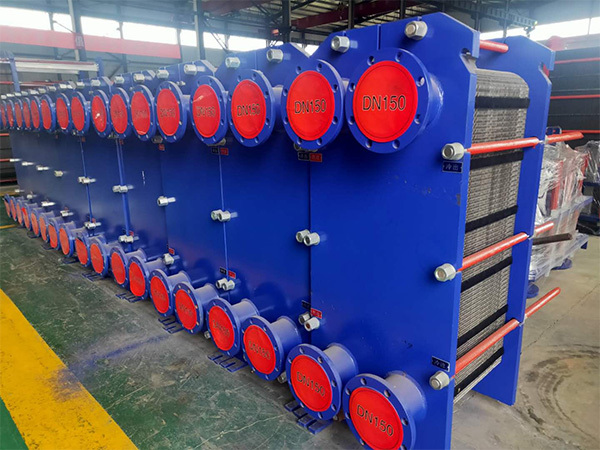
I. Advantages of Plate Heat Exchangers
Compared to other heat exchangers, plate heat exchangers have distinct advantages: high heat transfer coefficient, small footprint, compact structure, and easy maintenance. Under the same heat transfer conditions, the space occupied is only 1/2 to 1/3 that of shell-and-tube types. Unlike shell-and-tube exchangers, it doesn't require a large space to pull out the tube bundle for maintenance; simply loosening the clamping screws allows 100% access to the heat transfer plate surface within the original space for easy disassembly and cleaning. Its small size, light weight, and ease of installation make it suitable for confined spaces. Heat exchanger manufacturers indicate that the above comparative analysis reveals numerous advantages of plate heat exchangers over shell-and-tube types. Furthermore, plate heat exchangers offer the following advantages:
(1) Small Temperature Difference
Due to the high heat transfer coefficient and strong turbulence, the temperature difference between the primary and secondary hot water in the heat exchanger after heat exchange is very small, sometimes approaching 1-3°C. This significantly improves thermal efficiency and the economic viability of the heat exchange equipment.
(2) Low Heat Loss
Because the edges and surrounding gaskets of the plates are exposed to the atmosphere, heat loss is minimal, generally around 1%, eliminating the need for insulation. With the same heat transfer area, heat loss is only 1%, and the weight is less than half that of a shell-and-tube type.
(3) Strong Adaptability
On the one hand, when assembling the heat exchanger, heat transfer plates can be easily added or removed according to production and process requirements, and the heat transfer plates can be rearranged and process combinations reselected. On the other hand, adaptability is also reflected in its applications. Heat exchanger manufacturers indicate that they are currently widely used in various engineering fields, including chemical engineering, machinery, cement, petroleum, power generation, and hot water heating. They are specifically used in heating, cooling, evaporation, condensation, and waste heat recovery processes, achieving their application purpose through heat exchange between media in the plate heat exchanger.
(4) Flexible Operation and Easy Maintenance
The heat transfer plates and movable pressure plates are hung on the machine's crossbeams, with rolling devices above the pressure plates for convenient opening of the equipment for cleaning, and plates can be removed for inspection or gasket replacement.
In summary, plate heat exchangers, with their high heat transfer efficiency, small size, and light weight, are ideal heat exchangers when the cooling water quality is good.
Related News
WeChat Mini Program
WeChat public account
Service line:
Mobile:+86-15064136769
+86-13869137166
Mailbox:zhilin@sdzhilin.cn
Address: South Park, Jinan Economic Development Zone, Shandong Province