

What are the applications of plate heat exchangers in our daily lives?
Release time:
2022-06-24 14:41
Source:
Plate heat exchangers are a new type of heat exchanger, composed of a series of corrugated metal plates. Thin rectangular channels are formed between the plates, allowing for heat exchange through the plates. Jinan plate heat exchangers have characteristics such as high heat exchange efficiency, low heat loss, compact and lightweight structure, small footprint, convenient installation and cleaning, wide application, and long service life. Under the same pressure drop, its heat transfer coefficient is 3-5 times higher than that of a shell and tube heat exchanger, the footprint is one-third that of a shell and tube heat exchanger, and the heat recovery rate can reach over 90%.
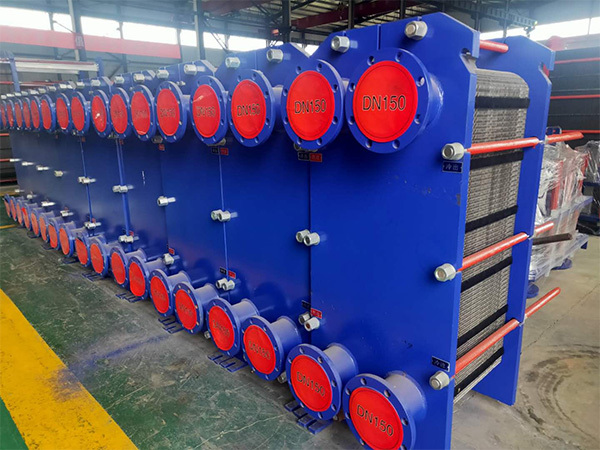
Plate heat exchangers consist of an equilibrium tank, a centrifugal sanitary pump, a hot water device (including steam piping and hot water injector), a support frame, and an instrument box. Used for sterilizing and cooling milk or other heat-sensitive liquids. The material to be processed first enters the equilibrium tank, then is sent to the heat exchanger by the centrifugal sanitary pump, and undergoes preheating, sterilization, heat preservation, and cooling. Any material that does not reach the sterilization temperature is redirected by the instrument-controlled pneumatic return valve to the equilibrium tank for reprocessing.
What are the applications of Jinan plate heat exchangers in our daily lives? Let's share a summary! In summary, Jinan plate heat exchangers play a role in the following three areas of life!
1. Central Heating
Jinan plate heat exchangers are compact in structure, easy to operate, and easy to clean. Cleaning only requires opening the clamping bolts, which is something shell and tube heat exchangers cannot match. Moreover, their heat transfer coefficient is very high, making them the primary heat exchange product in most urban central heating projects. They are suitable for water-water heat exchange systems, steam-water heat exchange systems, and daily residential hot water supply systems, playing a crucial role in improving management levels and rationally allocating thermal energy.
2. Air Conditioning Systems
Due to their low price, Jinan plate heat exchangers are widely used for heat exchange of chilled water in air conditioning systems. Installing a plate heat exchanger near the condenser between the cooling tower and the condenser can act as a condenser, preventing equipment corrosion or blockage and saving running time for chiller units during the transitional seasons.
3. High-Rise Building Pressure Breaker
In high-rise buildings, HVAC systems containing water, ethylene glycol, and other heat transfer media often have high static pressure. Using a Jinan plate heat exchanger as a pressure breaker can decompose the high static pressure into several smaller pressures, thereby reducing the pressure requirements of pumps, valves, chiller units, and other equipment, saving equipment investment and operating costs.
4. Ice Storage System
Ice storage systems using plate heat exchangers play a role in regulating the power grid by peak shaving and valley filling. That is, using chiller units to cool at night, the ice grows in the ice storage tank to meet the next day's cooling needs, reducing the peak load of air conditioning, thereby effectively saving energy and operating costs.
Related News
WeChat Mini Program
WeChat public account
Service line:
Mobile:+86-15064136769
+86-13869137166
Mailbox:zhilin@sdzhilin.cn
Address: South Park, Jinan Economic Development Zone, Shandong Province