

Working principle of intelligent heat exchanger unit
Release time:
2022-07-14 09:39
Source:
An intelligent heat exchanger unit is a pre-assembled unit consisting of a plate heat exchanger, water pumps, valves, filters, switchgear, inverters, instruments, and a control system, all connected via piping and mounted on a single base. After the unit is transported to the installation site, connecting the primary side, secondary side, and makeup water lines, and turning on the power supply allows the unit to commence operation. The unit is also characterized by its compact structure, convenient long-distance transportation, small footprint, and flexible installation location. Let's take a look at the working principle of the intelligent heat exchanger unit.
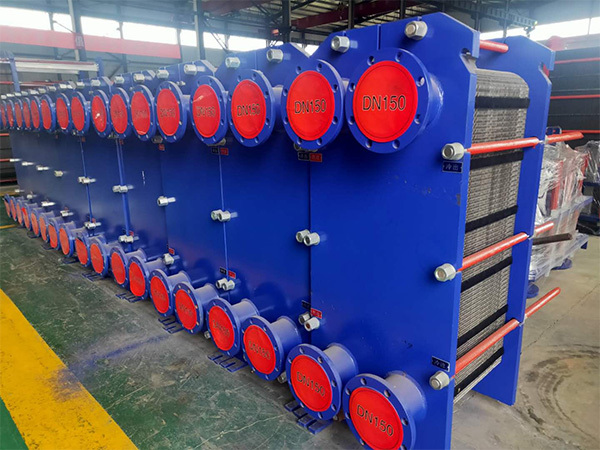
Working Principle of the Intelligent Heat Exchanger Unit
1. The process unit consists of a makeup water system. The primary side refers to the supply side of heat or cold, and the secondary side refers to the receiving side of heat or cold. One side uses a plate heat exchanger to transfer heat or cold to the secondary side; the secondary side does not have a circulation pump; it uses circulating water to transfer the heat or cold to the user.
2. The control principle unit uses an automatic control system for automatic and remote monitoring of the unit, achieving unmanned automatic operation of the power station. The unit control consists of a controller with host functions, a control cabinet, sensors, actuators, and a communication system. Through sensors and actuators connected to the controller, water channels are set up in the heat exchanger and other factory buildings to complete the collection and control functions; the actuator should include temperature sensors or temperature transmitters, outdoor temperature sensors, pressure transmitters, differential pressure transmitters, flow meters, heat meters, liquid level transmitters, electric control valves, inverters, and solenoid valves, etc.
3. Parameters measured by the intelligent heat exchanger unit: Outdoor temperature; primary and secondary side inlet and return water temperatures; condensate pressure; water supply flow rate; makeup water flow rate; makeup water tank level; start/stop and running status of the circulation pump and makeup pump, etc.
4. Actuators: Primary side electric control valve, secondary side circulation pump inverter, makeup pump inverter, and solenoid valves, etc., plate heat exchanger.
5. Temperature control unit: Other units control the primary side electric control valve based on the secondary side water supply temperature. The adopted unit allows direct manual setting of the secondary side water supply temperature, return water temperature, or average temperature to control the primary side electric control valve; the operation mode for on-duty heating can be set manually; adjust the primary side electric control valve, etc.
6. When the makeup water temperature does not decrease, pressure control can adjust the supply and return water pressure difference at the specified pressure on the side to control the operating frequency of the secondary side circulation pump; or directly set the operating frequency of the secondary side circulation pump; according to the set makeup water pressure, control the operating frequency of the makeup pump with a solenoid valve; when the system pressure exceeds the set pressure, the solenoid valve automatically releases condensate.
7. Communication system unit: The controller can communicate data with the monitoring center through standard communication protocols in both active and passive modes. In addition, the intelligent heat exchanger unit has display and operation functions, allowing for on-site modification and setting of parameters, alarm settings, etc.
The above is an introduction toWorking Principle of the Intelligent Heat Exchanger Unit. For more information, please feel free to contact us! Our company has many years of experience and we look forward to your participation.
Related News
WeChat Mini Program
WeChat public account
Service line:
Mobile:+86-15064136769
+86-13869137166
Mailbox:zhilin@sdzhilin.cn
Address: South Park, Jinan Economic Development Zone, Shandong Province