

Advantages of plate heat exchangers
Release time:
2022-09-22 09:33
Source:
Advantages of plate heat exchangers
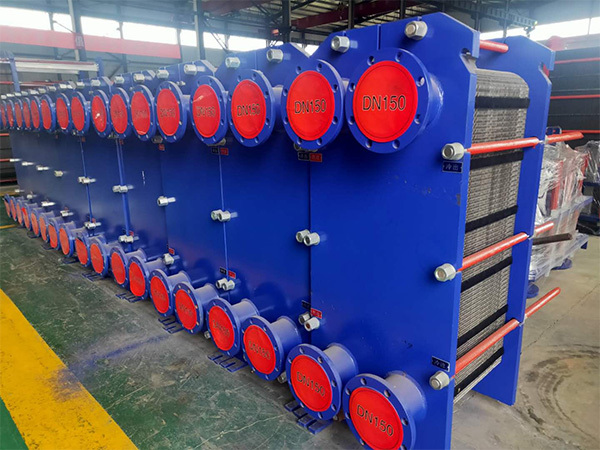
Plate heat exchangers, also known as detachable plate heat exchangers, are compact and highly efficient heat exchangers. Initially mainly used in milk processing, due to their small size, easy disassembly, and cleaning, they are widely used in food processing, beverage, beer processing, and pharmaceutical processing.
To date, plate heat exchangers are widely used in shipbuilding, chemical engineering, energy, metallurgy, waste heat recovery, and central heating industries, serving as heaters, coolers, and even evaporators and condensers in refrigeration systems. Plate heat exchangers have significant advantages for some special process fluids, such as the condensation of multi-component steam and heat transfer between media with different boiling points.
High heat transfer efficiency, low heat loss, easy heat recovery, can reach1℃ temperature difference. When the two media are in full counter-current flow, for water-water heat transfer, the terminal temperature difference can reach 1℃, which is advantageous for waste heat recovery processes, and the recovery rate can reach about 90%. The small size and compact structure of plate heat exchangers eliminate the need for large maintenance space during installation and can enhance heat exchange. Low cost and lightweight, the heat transfer area can be increased or decreased, and with the same heat exchange, the heat transfer area is smaller than that of tube heat exchangers, reducing user costs; the heat transfer area can be increased or decreased according to process requirements. The equipment we commonly use is mostly V-shaped design, while the adhesive cooling wide-channel plate heat exchanger plate uses plane corrugation, and the unique coarse texture structure design makes the wide gap channel smooth. There is no metal contact point between the plates, the fluid flows smoothly, no retention, no dead zone, no blockage, and the flow channel width between the plates can reach 6-16m. The medium can pass through the heat transfer surface of the plate without any blockage phenomenon. It can be said that it is a research and development equipment specifically for various solid, crystalline, fibrous, slurry, or viscous media that are easy to block heat transfer conditions.
Easy maintenance and cleaning, simply loosen the screws on both sides, saving maintenance costs and time. Please read the attached(installation and use instructions) carefully during installation. Lifting holes are designed on the equipment frame for lifting and must not be lifted from other parts of the equipment. The equipment can be placed directly on the indoor cement floor and needs to be placed horizontally. If necessary,needto be fixed to the ground with screws, the recommended dimensions around the outflow are used to ensure reasonable and good working conditions during equipment installation and maintenance. Before connecting the equipment to the pipeline,needclean the pipeline thoroughly. No rust, sand, oil stains, or welding slag can enter the heat exchanger. To ensure operational safety, filters should be installed at appropriate locations on the connection between the equipment and pipelines. The heat exchanger is connected to the pipeline system. Do not cause stress between the heat exchanger and the pipeline system. The water pressure test should be carried out unilaterally. The test pressure is 1.3 times the design pressure of the equipment, and the pressure is maintained for 30 minutes. Check all seals and welds for leaks. No leakage is considered qualified.
Related News
WeChat Mini Program
WeChat public account
Service line:
Mobile:+86-15064136769
+86-13869137166
Mailbox:zhilin@sdzhilin.cn
Address: South Park, Jinan Economic Development Zone, Shandong Province