

How can I tell if a heat exchanger is performing well?
Release time:
2022-12-23 13:19
Source:
Heat exchanger units are widely used in our lives, mainly in factories, residential areas, and office spaces. Different heat exchanger units have certain differences in design performance. So, how do we assess the performance of a heat exchanger unit?Let's take a look.
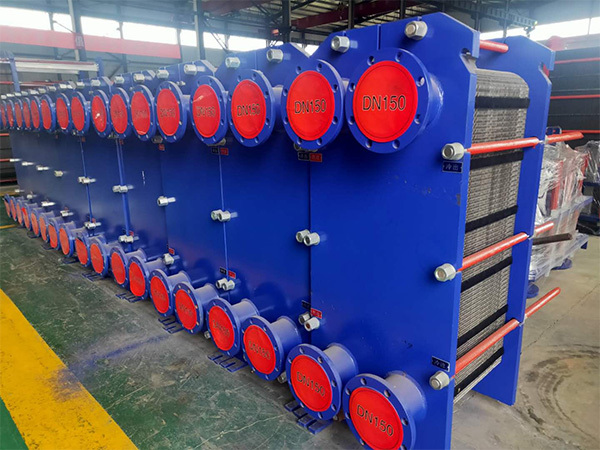
1. CalculationHeat Exchanger UnitThe heat transfer capacity of copper tubes and aluminum foil, to see if the material usage is reasonable;
2. Calculate the length-to-area ratio of the effective heat exchange manifold of the condenser and evaporator to see if the indoor and outdoor heat exchange capacity is reasonably matched;
3. Analyze the suction and discharge pressure of the system. Different energy efficiency levels require different suction and discharge pressures. The higher the energy efficiency level, the lower the power consumption requirement of the compressor. The smaller the suction pressure difference, the smaller the pressure loss of the system.
4. Check and analyze the tube temperature of the inlet and outlet heat exchangers.Heat Exchanger UnitThe inlet and outlet temperatures can indirectly reflect the evaporation and condensation pressure, especiallyHeat Exchanger Unitthe temperature, directly reflectsHeat Exchanger Unitthe degree of subcooling and the degree of superheat of the evaporator, directly reflecting the heat exchange effect. EvaporativeHeat Exchanger Unitreturn temperature is too low, it is easy to causeheat exchangersurface frosting or even icing, leading to a vicious cycle of the system. CondensationHeat Exchanger Unittemperature is too high, the degree of subcooling is small, and the performance decreases.
5. CheckHeat Exchanger Unitwhether the windward temperature distribution is uniform. A uniform temperature distribution indicates a better multi-channel state, and the heat exchange efficiency of each channel is basically the same, which is consistent with the counter-flow pipe of the indoor and outdoor temperature difference, which is conducive to improving the overall efficiency of the heat exchanger. If the temperature distribution is uneven, it indicates that the multi-channel distribution state is not good, and the heat exchange efficiency of some pipes is poor and cannot be fully utilized. At the same time, it will affect the degree of subcooling and superheat, affecting the heat exchange effect of the entire system.
6. Look at multiple rowsHeat Exchanger Unitwhether there is reverse heat exchange. Generally negative pressure ventilation heat exchange.(such as split outdoor units, wall-mounted indoor units) the external drain pipe and internal exhaust pipe meet the reverse heat exchange; positive pressure heat exchangers (such as window units, floor-standing units, embedded indoor units) internal drain pipes and exhaust pipes perform reverse heat exchange; for multi-row heat exchangers, the temperature difference between the inside and outside of the pipe is relatively small. The inner and outer pipes of the heat exchanger can maintain a certain temperature difference, and the heat exchange efficiency of the inner and outer pipes is higher. The evaporator can increase the flow rate in the heat exchange tube to improve the heat exchange efficiency.
The above is the heat exchanger unit manufacturer's explanation of the judgment of the design performance of the heat exchanger unit. Hope it helps you. In fact, the design performance of the heat exchanger unit will directly affect ourusage effect and our heating. Therefore, when purchasingHeat Exchanger Unitwe should not only look at the price, but also its service life and design performance.
We areheat exchanger unit manufacturersIf you want to learn more about this, please contact us. We can introduce it to you from different aspects, so that you can have a more detailed understanding of this aspect.
Related News
WeChat Mini Program
WeChat public account
Service line:
Mobile:+86-15064136769
+86-13869137166
Mailbox:zhilin@sdzhilin.cn
Address: South Park, Jinan Economic Development Zone, Shandong Province