

Plate Heat Exchanger: Why use a plate heat exchanger?
Release time:
2020-11-24 15:07
Source:
www.sdzhilin.cn
Plate heat exchanger Speaking of plate heat exchangers, many people may not be familiar with them. I can tell you that they are used in home central air conditioning systems, for example. They are essential components.
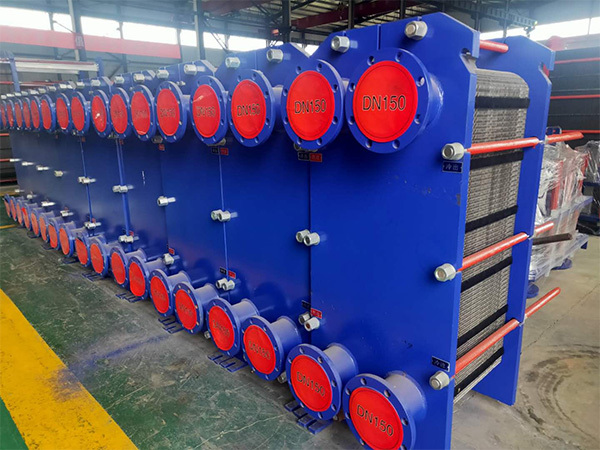
Zhilin recommends using a plate heat exchanger because:
1. In water system air conditioners, the internal fluorocarbon-water heat exchanger is responsible for heat transfer with the secondary refrigerant. There are generally three types of heat exchangers: A. Shell and tube heat exchanger; B. Shell and tube heat exchanger; C. Plate heat exchanger. A and B are generally used in large and medium-sized units, with advantages such as low pressure loss, low water requirements, and low clogging risk. C is generally used in small and medium-sized units, with advantages of small size and high efficiency. If it's a water system server, a heat exchanger is definitely needed, whether it's a plate type or another type. Removable heat exchanger manufacturer

2. In air source central air conditioning water systems using small and medium-sized heating boilers for auxiliary heating, a plate heat exchanger (generally a plate type) is connected in series after the circulation pump on the main pipe and before the outdoor unit. This is used for heat transfer between the air conditioning unit water and the boiler heating water (the boiler has two control loops for heating and domestic hot water). When used in winter, the boiler temperature is set, the furnace is fired, and when the set temperature is reached, the heating circulation pump starts working, and the water is output to the heat exchanger for circulation to heat the intelligent return water on the air conditioning unit main pipe. Heating unit

If, to save costs and reduce construction costs, the heat exchanger is removed, the heating boiler needs to be connected in series to the main pipe. During winter use, the main system circulation pump will compete for water with the heating boiler's heating circulation pump, resulting in insufficient heating water output from the boiler and the boiler failing to provide heating. Another way to remove the heat exchanger is to add a shut-off valve or stop valve to the section of the main pipe where the boiler is connected in series, closing the valve during heating and removing the boiler circulation pump.
Because this is equivalent to connecting the boiler to the central air conditioning pipeline system, the small circulation pump of the furnace will restrict the flow of the main system circulation pump, so it must be removed. This situation can only be used when the boiler provides auxiliary heating but does not provide domestic hot water, otherwise, due to the basic principles of the boiler structure, if the air conditioner is turned on, the domestic hot water will not be able to heat up. Therefore,
This is why a plate heat exchanger is essential. The above also shows the function of the heat exchanger in these devices, and what problems arise once there is no heat exchanger.
The above content was compiled by Shandong Zhilin Environmental Protection Technology Co., Ltd. Please contact us if you have any needs.
Next Page
Related News
WeChat Mini Program
WeChat public account
Service line:
Mobile:+86-15064136769
+86-13869137166
Mailbox:zhilin@sdzhilin.cn
Address: South Park, Jinan Economic Development Zone, Shandong Province