

Plate Heat Exchanger: Comparison of Plate Heat Exchanger and Shell and Tube Heat Exchanger
Release time:
2020-12-21 13:35
Source:
www.sdzhilin.cn
Plate heat exchangers and shell and tube heat exchangers are both popular heat exchangers on the market today. Customers often compare them in terms of price and performance to choose a more suitable product.
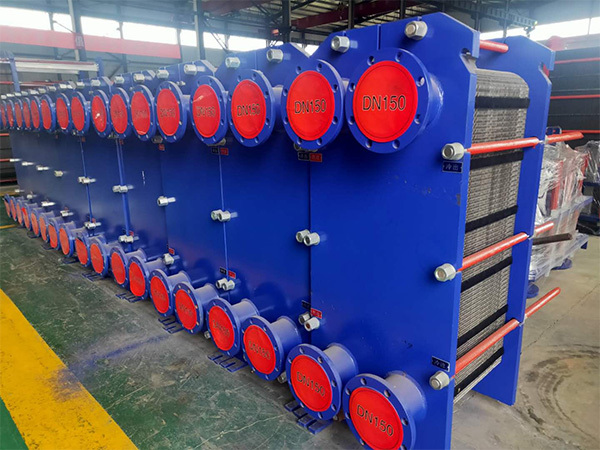
Zhilin recommends a comparison of plate heat exchangers and shell and tube heat exchangers:
1. High thermal conductivity:Because different corrugated plates are interlocked to form complex flow passages, the liquid flows in a rotating three-dimensional manner in the flow passages between the corrugated plates, which can generate a flow field at a lower flow resistance (generally Re = 50-200). Therefore, the thermal conductivity is high, generally considered to be 3-5 times that of shell and tube type. Heat exchanger

2. Large logarithmic mean temperature difference and small terminal temperature difference:In shell and tube heat exchangers, the two liquids flow in the tube side and shell side respectively. The overall flow is countercurrent flow. The correction coefficient of the logarithmic mean temperature difference is small, while plate heat exchangers are mostly parallel flow or countercurrent flow methods, and their correction coefficients are generally around 0.95. In addition, the cold and hot liquids flow in the plate heat exchanger parallel to the heat transfer surface and there is no bypass, which leads to a small terminal temperature difference in the plate heat exchanger, which can be less than 1 ℃ for water heat transfer, while shell and tube heat exchangers are generally 5 ℃. Plate heat exchanger unit

3. Small footprint:Plate heat exchangers have a compact structure, and the total heat transfer area in the unit volume is 2-5 times that of shell and tube type. Unlike shell and tube type, it does not require a maintenance space for removing and pulling out pipes. Therefore, for the same heat exchange amount, the footprint of plate heat exchanger is about 1/5-1/8 of that of shell and tube heat exchanger.
4. Easy to change the heat transfer area or process configuration:Increasing or decreasing the number of plates can increase or decrease the heat transfer area. Changing the plate arrangement or replacing multiple plates can achieve the required process configuration, adapting to new heat transfer working conditions. The heat transfer area of shell and tube heat exchangers is basically impossible to increase.
5. Lighter weight:The thickness of the plate of plate heat exchanger is only 0.4-0.8 mm, while the thickness of the heat dissipation tube of shell and tube heat exchanger is 2.0-2.5 mm, and the shell of the shell and tube type is much heavier than the frame of the plate heat exchanger. The plate heat exchanger is generally only about 1/5 of the weight of the shell and tube type.
6. Low price:Using the same materials, the price of plate heat exchangers is about 40%-60% lower than that of shell and tube heat exchangers under the same heat transfer area.
7. Convenient manufacturing:The heat transfer plates of plate heat exchangers are made of stamping parts, with high standardization level, and can be mass-produced. Shell and tube heat exchangers are generally handmade.
8. Easy to clean:For frame-type plate heat exchangers, the plate bundle can be loosened and the plates can be removed for mechanical cleaning by loosening the clamping bolts. This is very convenient for heat transfer processes that require frequent cleaning.
9. Small heat loss:Plate heat exchangers only have the casing plates of the heat transfer plates exposed to the air, so the heat loss can be ignored, and no insulation measures are needed. Shell and tube heat exchangers have large heat loss and need insulation.
10. Smaller volume:It is 10%-20% of the shell and tube heat exchanger.
11. Large pressure drop per unit length:Due to the small gap between the heat transfer surfaces and the uneven heat transfer surface, the pressure drop is larger than that of traditional smooth tubes.
12. Not easy to scale:Due to sufficient internal turbulence, it is not easy to scale, and its scaling index is only 1/3-1/10 of that of shell and tube heat exchangers.
13. Pressure should not be too high, and substance temperature should not be too high, otherwise leakage may occur. Plate heat exchangers use gaskets for sealing, and the pressure should generally not exceed 2.5 CPa, and the substance temperature should be below 250 ℃, otherwise leakage may occur.
14. Easy to block:Because the channels between the plates are narrow, generally only 2-5 mm, when the heat transfer substance contains large particles or fiber materials, it is easy to block the channels between the plates.
The above is the content collected by the editor of Shandong Zhilin Environmental Protection Technology Co., Ltd. Please contact us if you need it.
Related News
WeChat Mini Program
WeChat public account
Service line:
Mobile:+86-15064136769
+86-13869137166
Mailbox:zhilin@sdzhilin.cn
Address: South Park, Jinan Economic Development Zone, Shandong Province