

What is a Jinan plate heat exchanger? What are its advantages and applications?
Release time:
2022-06-14 17:34
Source:
Jinan plate heat exchangers are made by stamping a thin metal plate (usually steel or stainless steel) into a corrugated groove with a certain regular shape, and then assembling the plates into the required multi-plate group. At the edges of two adjacent plates, materials such as nitrile rubber are used as sealing gaskets to form channels for the medium flow path. Fluid inlets and outlets are set up, allowing two media to flow and exchange heat in their respective channels. Due to the complex corrugated shape of the channel, although the medium flows at low speed, turbulence is formed in the groove, improving the heat exchange rate. At the same time, the number of grooves increases the heat exchange area, so it is a fast heat exchange equipment.
Jinan plate heat exchangers have high heat transfer efficiency, small footprint, low heat loss, simple structure, easy handling and installation, convenient disassembly, flexible heat consumption adjustment, and can be regularly cleaned or replaced. The number of plates can be increased with the increase of heat consumption without replacing any equipment (such as when the volumetric heat exchanger cannot meet the demand for increased capacity, it needs to be replaced or added). Jinan plate heat exchangers are often used in heating or air conditioning systems, such as domestic hot water systems, and need to be equipped with hot water storage tanks.
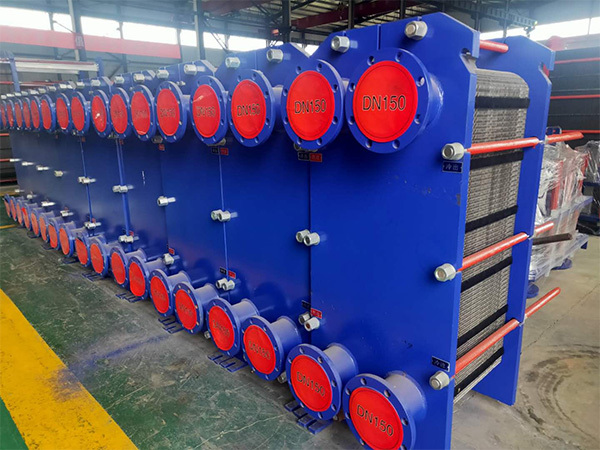
Advantages of Jinan Plate Heat Exchangers:
1. High heat transfer coefficient. The Jinan plate heat exchanger is assembled from inverted plates. The corrugated shape of the plates forms complex flow channels, causing the heat transfer medium to generate strong turbulence, thus resulting in a high heat transfer coefficient.
2. Compact structure, small footprint, heat transfer area per unit volume can reach 250.
3. Large logarithmic mean temperature difference, small end temperature difference. Jinan plate heat exchangers are mostly in parallel flow or countercurrent flow, and the logarithmic mean temperature difference correction coefficient is about 0.95. The flow of hot and cold fluids is parallel to the heat transfer surface, there is no bypass flow, and the end temperature difference is small, so the water-water heat exchange can be below 1.
4. Easy to change the heat transfer area or process combination. If you want to increase or decrease the heat transfer area, simply add or remove plates; if you want to change the process combination, you only need to change the arrangement of the plates or replace a few plates to adapt to new heat exchange conditions.
5. Low cost. Mainly using metal plates, raw material prices are lower than metal pipes.
6. Not easy to scale. The fluid is greatly disturbed in the flow channel, and fouling is not easy to deposit.
7. Easy to disassemble and clean. Just loosen the clamping bolts, move the movable end plate, and you can remove the plate for cleaning, suitable for frequent cleaning and maintenance.
8. High heat transfer coefficient. The flow channel of the Jinan plate heat exchanger is small, and the plate is corrugated, with a complex cross-sectional change, which makes the flow direction and flow rate of the fluid constantly change, increasing the fluid disturbance, and thus achieving turbulent flow at a very low flow rate, with a high heat transfer coefficient. It is especially suitable for liquid-liquid heat exchange and heat exchange between fluids with large temperature differences.
Related News
WeChat Mini Program
WeChat public account
Service line:
Mobile:+86-15064136769
+86-13869137166
Mailbox:zhilin@sdzhilin.cn
Address: South Park, Jinan Economic Development Zone, Shandong Province